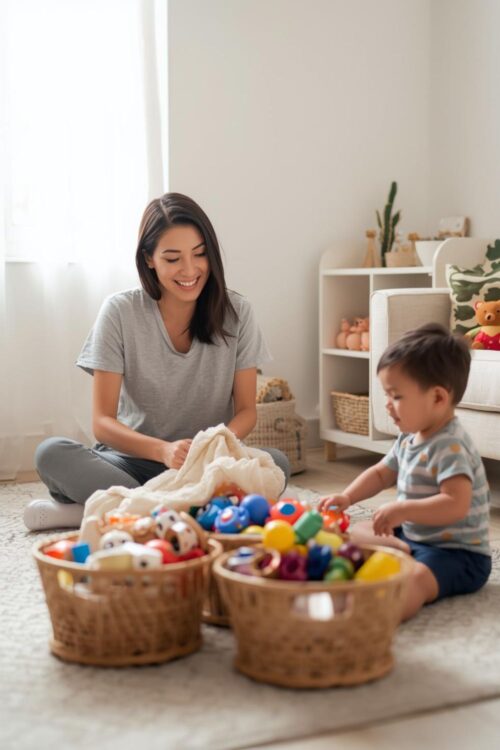
How to Declutter Toys Without Tears (From a Mom Who’s Done It the Wrong Way First)
I used to wait until I couldn’t take it anymore.
You know the moment — when you step on a tiny plastic dinosaur for the fourth time in one day, trip over a dump truck while carrying laundry, and suddenly decide everything has to go.
That’s when I would announce, in full overwhelmed-mom mode:
“Okay. We’re cleaning out toys. Right now.”
It did not go well.
There were tears.
There was clutching.
There was dramatic collapsing onto the floor over a broken crayon.
And honestly? It wasn’t really about the toys.
It was about how I handled it.
Over time (and a few failed decluttering attempts), I figured out how to declutter toys without turning it into an emotional disaster — for them or for me.
Here’s what actually worked in our house.
First: I Stopped Decluttering At My Kids
The biggest shift for me was realizing I didn’t need to involve them in every single decision.
When I used to dump out bins and say, “Pick what you want to keep,” I was overwhelming them. Of course they wanted to keep everything. I would too if someone suddenly told me to choose my favorite possessions under pressure.
Now, I quietly declutter in small pockets of time.
While they’re sleeping.
While they’re outside.
While they’re watching a show.
And I only remove the obvious things:
- Broken toys
- Missing pieces
- Things they’ve clearly outgrown
- Party favor junk that somehow multiplied
They have never once asked about the cracked plastic whistle from a birthday party three months ago.
Not once.
I Follow the “If It Hasn’t Been Touched in Months” Rule
I started paying attention to what they actually play with.
There are always a few toys that live permanently in the spotlight — the doll that goes everywhere, the trucks that are constantly lined up, the magnetic tiles that get dumped daily.
And then there are the toys that sit untouched on a shelf collecting dust.
If I haven’t seen it played with in 3–6 months, it quietly leaves.
No announcement.
No big moment.
No drama.
I realized most attachment comes from being asked to choose — not from the actual toy.
I Rotate Instead of Remove (At First)
This was a game-changer for me.
Instead of immediately donating everything, I started creating a small “toy timeout bin.”
I put toys I suspected they wouldn’t miss into a storage tote in a closet.
If no one asks about them for a month or two? I donate them.
If they do ask? I rotate them back in and remove something else.
It takes the pressure off me and keeps me from second-guessing every decision.
And honestly? 90% of the time, they never notice.
I Stopped Treating Every Toy Like It Was Sentimental
This one was more about me than them.
I realized I was holding onto things because:
- “Grandma gave that.”
- “That was expensive.”
- “They used to love that.”
But our home isn’t a storage unit for past stages.
I had to remind myself:
We’re making space for who they are now.
When I shifted my mindset from “getting rid of memories” to “making room for current play,” it felt lighter.
I Made Toy Storage Smaller on Purpose
When we had giant bins, we filled them.
When we had large shelves, we packed them.
So I downsized the containers.
Smaller basket? Fewer stuffed animals.
Smaller bin? Fewer cars.
I don’t declutter constantly anymore because the space naturally limits the clutter.
And here’s something I didn’t expect:
The fewer toys we have out, the better they play.
Less overwhelm.
More creativity.
Longer independent play.
I used to think more toys meant more entertainment.
It turns out it just meant more mess.
I Let Go of the “Perfect Playroom” Idea
For a while, I thought decluttering meant creating some Pinterest-worthy, neutral, labeled, aesthetic toy space. But what actually helped was focusing on function over perfection — something I talk more about in my post on creating a fun, organized toddler playroom.
Our living room still looks lived in. There are still toys under the couch sometimes. We are still very much in the toddler years.
Decluttering for me isn’t about perfection.
It’s about being able to:
- Walk through the room without stepping on something
- Reset the house in 10 minutes at night
- Not feel overstimulated by stuff
That’s it.
What I Do Now (A Simple Routine That Works)
Instead of doing one big purge, I:
- Do a small sweep once a month
- Remove broken or random clutter weekly
- Rotate toys seasonally
- Keep storage intentionally limited
It feels calm instead of chaotic.
And most importantly?
No tears.
Not theirs.
Not mine.
If You’re Drowning in Toys Right Now
I’ve been there.
I’ve looked around and felt like the house was shrinking under plastic clutter. I’ve felt guilty for wanting to get rid of things that were gifts. I’ve worried I was taking something important away.
But here’s what I’ve learned:
Kids don’t need as much as we think they do.
They need space to play.
They need room to imagine.
They need a calm parent more than they need a fifth set of blocks.
Start small.
Don’t announce it.
Remove the obvious things first.
You don’t need a dramatic overhaul.
Just one small bin at a time.
And I promise — it gets easier every time you do it.